
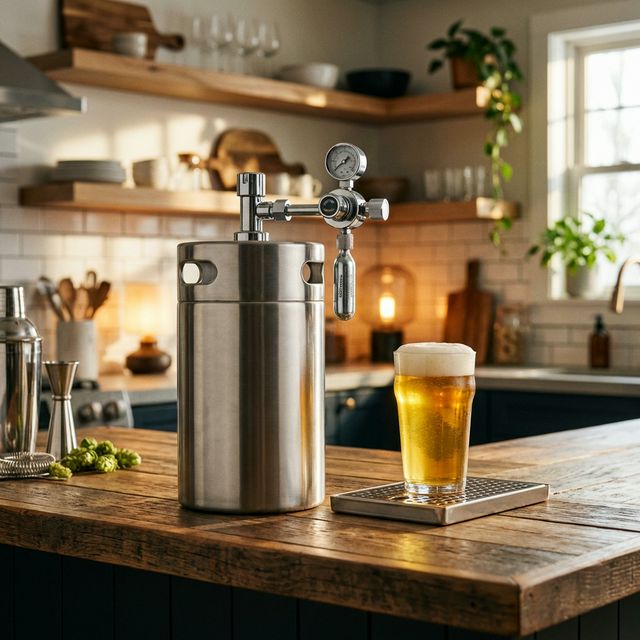
If you have finally committed to building your home draft system—whether that is a massive dual-tap kegerator in your garage or a sleek portable Keg Smiths Mini Keg for your countertop—you are likely focused on the liquid. You’ve picked the perfect craft IPA, thoroughly cleaned your beer lines, and dialed in your temperature.
But there is an invisible, often-overlooked ingredient that can make or break your perfect pour: the gas.
When it comes to carbon dioxide (CO2), not all gas is created equal. If you are serving beverages to yourself, your friends, or your family, understanding the difference between standard industrial CO2 and true Beverage Grade CO2 is absolutely critical.
Here is everything you need to know about beverage gas, why purity matters, and how it impacts the flavor and safety of your draft drinks.
What is Beverage Grade CO2?
Carbon dioxide is a naturally occurring gas that is captured and refined for thousands of industrial, medical, and agricultural uses.
The term "Beverage Grade" is a specific classification enforced by agencies like the FDA (Food and Drug Administration) and the ISBT (International Society of Beverage Technologists). To earn the "Beverage Grade" label, the CO2 must meet rigorous purity standards—specifically, it must be at least 99.9% pure carbon dioxide.
More importantly, it must undergo specific filtration processes to ensure the remaining 0.1% does not contain any toxic impurities or off-flavor-inducing compounds.
Industrial vs. Food Grade vs. Beverage Grade
When you go to a local welding supply store or an uncertified gas exchange, you might be handed a tank of "Industrial Grade" CO2.
- Industrial Grade CO2: Used for welding, paintball guns, and agriculture. The purity level is typically around 99.5%. The remaining 0.5% can contain trace amounts of oil (lubricants from the gas compressors), ammonia, benzene, or other volatile hydrocarbons. You should never push beer with industrial CO2.
- Food Grade CO2: Often used for freezing or packaging food. It is highly filtered and safe for human contact, but the stringent testing for aromatics (smell) and flavor isn't always as rigorous as it needs to be for liquids.
- Beverage Grade CO2 (99.9%+ Purity): This gas is filtered through activated carbon and specialized traps to ensure absolutely zero aromatic hydrocarbons, sulfur compounds, or compressor oils make it into the cylinder. This ensures that the gas passing through your Regulator and into your beer is perfectly clean.
Why Does CO2 Purity Matter for Draft Beer?
You might think that saving a few dollars by filling up your tank at a paintball shop won't hurt, but using the wrong gas can destroy a keg of beer in hours for three main reasons:

1. The Risk of Off-Flavors
Carbon dioxide interacts deeply with the liquid it dissolves into. It doesn't just push the beer out of the tap; it becomes part of the beverage. If your CO2 contains even microscopic trace amounts of sulfur, your beer will taste like rotten eggs. If it contains compressor oil blow-by, your fresh, bright IPA will suddenly taste metallic or greasy. Beverage Grade CO2 ensures your beer tastes exactly how the brewer intended.
2. Head Retention and Aromatics
A beer’s foamy head is created by CO2 bubbles rising to the surface, carrying the aromatic compounds of the hops and malt directly to your nose. If impurities in cheap gas mix with these bubbles, it kills the delicate foam structure (head retention) and replaces the intended aroma of the beer with chemical notes.
3. Food Safety
At the end of the day, whatever is in that gas cylinder is going directly into your body. Pushing liquids with industrial gas introduces the very real risk of ingesting harmful lubricants, benzene, or rust particles. Always prioritize health over a slightly cheaper gas refill.
How to Guarantee You Are Using the Right Gas
The easiest way to ensure you are serving safe, delicious draft beer at home is to control your CO2 source.
When dealing with large 5lb or 10lb CO2 tanks, always get your fills or exchanges from reputable sources:
- Local homebrew supply stores (who strictly sell beverage gas).
- Dedicated beverage gas suppliers.
- Certified welding supply hubs that explicitly offer "Beverage Gas Exchanges." Always ask to see their certification if you are unsure.
The Keg Smiths Solution: Precision Cartridges
If you are using a portable draft system for camping or home use, hauling around heavy tanks isn't practical.
This is why the Keg Smiths 8-Pint Draft System utilizes unthreaded 16g Dietary CO2 Cartridges.
Our recommended cartridges are packed under strict food-safe conditions, guaranteeing 99.9% pure Beverage Grade CO2 in every single cylinder. Because they are single-use, there is zero risk of tank contamination, rust, or improper refills. You simply screw a fresh cartridge into your Keg Smiths Regulator, set your perfect serving PSI, and pour with absolute confidence.
Respect the Gas
Draft dispensing is a science and an art. The next time you pour a pint from your home bar or mini keg, take a moment to appreciate the thousands of tiny, rising bubbles. By investing in true Beverage Grade CO2, you are protecting your health, preserving the brewer's art, and ensuring every single pour from your Keg Smiths System is a masterpiece.


Leave a comment
This site is protected by hCaptcha and the hCaptcha Privacy Policy and Terms of Service apply.